When Learning Left the Classroom: A Journey of Social Immersion in Siltara and Murethi
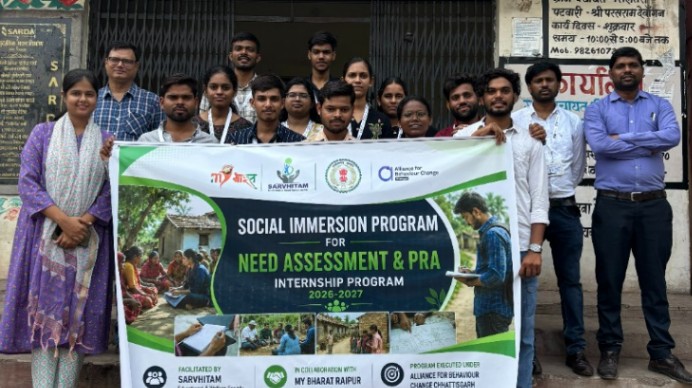
What happens when twelve young minds choose to wake up to the sound of village life instead of alarm clocks, share meals with families they had never met before, walk through dusty lanes with curious eyes, and listen more than they speak?
That is exactly what unfolded during the Social Immersion Programme, where 12 interns stepped into the villages of Siltara and Murethi not as visitors, but as learners.
For a few days, these villages became their classrooms.
Every morning began with conversations rather than lectures. Instead of notebooks filled with theories, they carried curiosity, empathy, and a willingness to understand people's realities.
The journey started with Transect Walks. Accompanied by villagers, the interns walked through fields, roads, water sources, schools, temples, anganwadis, and common spaces. Every path had a story. Every stop revealed something about the village—its strengths, its challenges, and the everyday lives of its people.
Transect Walk: A systematic walk through the village with community members to observe natural resources, infrastructure, land use, and local issues while gaining firsthand insights into community life.
As they walked, they realized that understanding a community begins with observing it.
The next step was Social Mapping.
Gathering with community members, the interns sat on the ground with chalk, sticks, and colored powders, drawing maps that reflected far more than geography. They identified households, public institutions, water sources, roads, and community assets. More importantly, these maps highlighted differences in access to resources and services, helping everyone visualize the realities that often remain unnoticed.
"Social Mapping: A PRA tool that helps communities visualize households, institutions, public facilities, and social groups to understand the village's social structure and access to resources."
Soon after came Cultural Mapping, a process that brought the heart of the villages to life.
The interns explored local traditions, festivals, customs, occupations, community gatherings, and places that held cultural significance. They discovered that every village possesses a unique identity shaped by its history, beliefs, and collective memories. Understanding these cultural roots became essential before thinking about any intervention or development effort.As conversations deepened, the villagers began sharing their concerns openly.
"Cultural Mapping: A participatory tool used to identify the traditions, festivals, customs, beliefs, occupations, and cultural landmarks that shape a community's identity."
Issues related to education, health, sanitation, livelihoods, public services, and community participation emerged naturally. But instead of jumping to conclusions or prescribing solutions, the interns chose a different path.
They listened.
They asked questions.
They encouraged discussions.
Using Participatory Rural Appraisal (PRA) tools, they facilitated spaces where community members themselves analyzed their situations. Villagers prioritized their own challenges, identified available resources, discussed possible solutions, and reflected on what they could achieve collectively.
It was a powerful reminder that sustainable change does not begin with outside experts it begins with people recognizing their own strengths.
The role of the interns was not to solve problems for the community but to help communities discover solutions that already existed within their collective wisdom.
PRA (Participatory Rural Appraisal): A community-based approach that enables local people to analyze their own situations, identify problems, assess available resources, and collectively plan solutions through participatory tools and discussions.
Over time, the relationship between the interns and the villagers transformed.
The interns were invited into homes, shared stories over evening tea, laughed with children, listened to the experiences of elders, and witnessed the resilience that often goes unnoticed in rural life.
They learned that development is not only about infrastructure or schemes—it is equally about trust, relationships, participation, and dignity.
For many interns, this was their first experience of living in a rural community. The immersion challenged assumptions, broadened perspectives, and strengthened their understanding of Social and Behaviour Change.
The immersion revealed several recurring concerns voiced by residents:
Water scarcity and access challenges
Pollution affecting the environment and quality of life
Alcohol consumption and its impact on families and community well-being
By the end of the programme, they returned with much more than field notes and research findings.
They carried stories of resilience.
They carried lessons in humility.
They carried a deeper appreciation for participatory development.
And most importantly, they carried the realization that the people closest to the problems are often the people closest to the solutions.
The Social Immersion Programme in Siltara and Murethi was not merely a research exercise.
It was a journey of listening before speaking, learning before leading, and walking alongside communities rather than ahead of them.
Because true social change begins not with answers—but with understanding.